
Somewhere in the Tushar Mountains of central Utah, an engineer named Garrett Aida is sliding down a scree field, chasing a mule deer he’s been patterning for hours. It’s the kind of moment bowhunters live for, except that his radio antenna has just snapped clean off, his GPS is glitching from its third soaking of the day, and the AA batteries powering his headlamp have shorted out. This wasn’t a one-off bit of bad luck. For reasons Aida still can’t fully explain, it seemed to happen on cue: a gorgeous morning, then a squall rolling straight over the ridge to drench, snow or hail on him, every single afternoon, for days on end.
Most people would file that under “should’ve packed a dry bag” and moved on. Aida filed it under “unsolved engineering problem.” At the time, his kit was about as basic as outdoor tech got – a simple phone, a handheld GPS, a radio, and a headlamp still running on single-use AAs rather than anything rechargeable. None of it much liked getting wet, and all of it was getting wet, repeatedly, on a mountain a long way from anywhere.

A little over a decade later, that frustration has become Dark Energy – a company whose battery packs have been shot with a 12-gauge, run over by a dump truck and dropped from heights that would write off most smartphones, and whose customer list runs from big-game hunters to special forces units.

Aida’s route into rugged electronics wasn’t exactly conventional. Home, growing up, was “wherever I happened to be” – a childhood spent moving between Pennsylvania, Ohio, the Philippines, Japan and China before eventually landing in Utah. By his own account he was always building something: as a young child he was teaching himself to design rockets and build potato cannons, using little more than early-internet forums and a fairly relaxed attitude to his own safety. It’s the kind of backstory that makes considerably more sense once you know what he does for a living now.
Before there was Dark Energy, there was a proper engineering job. Aida spent time at Cummins working on heavy-duty diesel engines, the sort of role where, as he puts it, a “1% margin of error meant a catastrophic failure.” That obsession with tolerances and failure points followed him off the clock. A committed bowhunter, paraglider, speed flier and spearfisherman – and, more recently, someone working towards a pilot’s licence purely for the fun of it – he kept running into the same issue with every battery pack, phone, GPS unit and radio he carried into the field: none of it was built for the way he actually lived.

Dark Energy’s first product wasn’t the battery it’s now best known for. In 2012, Aida launched a Kickstarter for a product called The Reservoir, an early portable charger that raised well over $170,000 and proved there was genuine appetite for a power bank built for daily use. It wasn’t perfect – “I made every mistake in the book that you could possibly make,” he admits – but it got the company off the ground. And even this early foray into the market tried to address some of the issues with existing products, shipping with a waterproof case for added protection and a short cable to prevent annoying tangles.
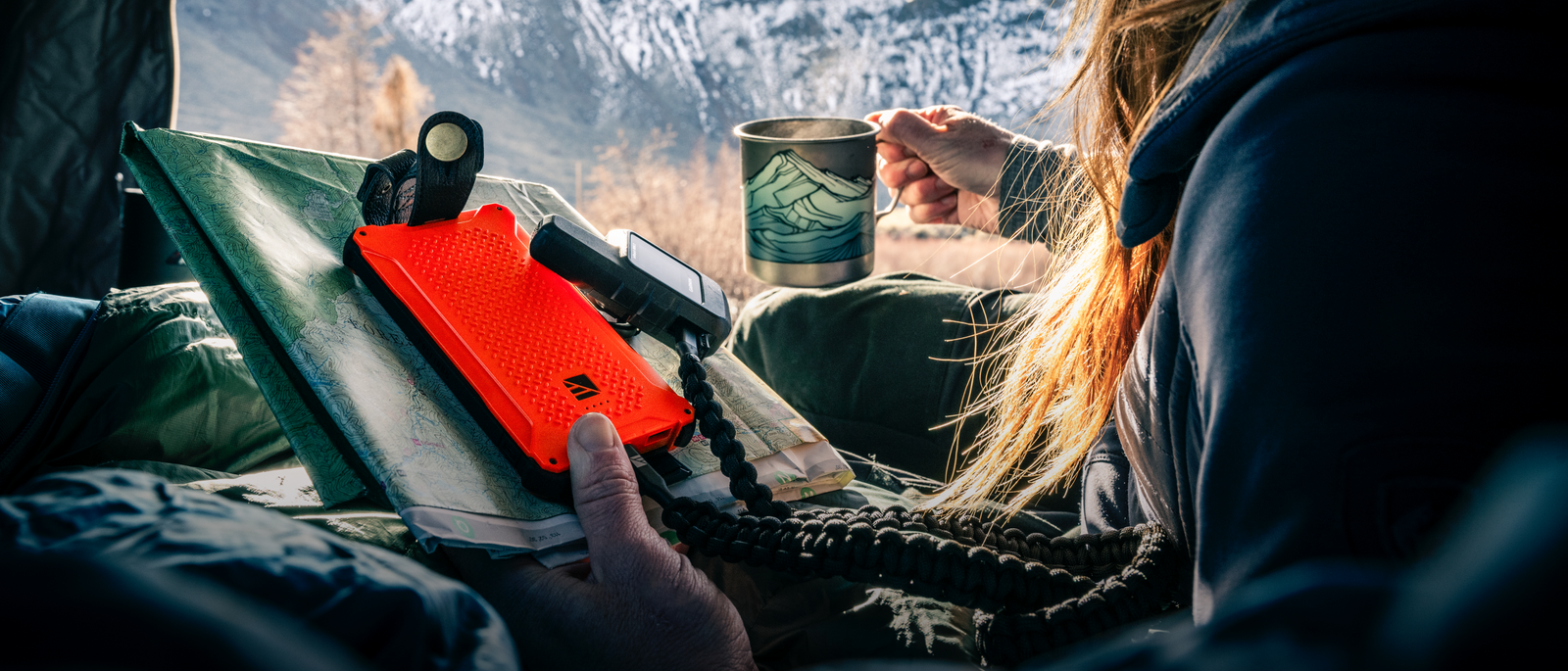
However, the product that actually defined the brand arrived a few years later, born directly out of that miserable, gear-frying hunt in the Tushars. Aida built what he needed for himself: a portable power bank that was genuinely waterproof, cold-tolerant, and able to survive being crushed in a back pocket while sliding down loose shale. He called it Poseidon, after the Greek god of the sea, for a fairly blunt reason: water and electricity, in his words, are “mortal enemies.” True to the name, Poseidon Pro is IP68-rated (good for 30 minutes fully submerged), has been drop-tested from 60 feet, run over by a dump truck and, because someone was bound to ask, shot with a shotgun.
When outdoor gear site GearJunkie got hold of an early Poseidon, their reviews team threw it off a 70-foot tower, hurled it down a paved path, dropped it off a 30-foot overpass and left it underwater for twenty hours. Afterwards, there was barely a mark on the case. Founder Steven Regenold called it, simply, “the toughest battery pack the site had tested”.

Dark Energy went back to Kickstarter a second time to fund Poseidon’s move into full production, and backers put in over $100,000 to make it happen – a reasonable vote of confidence for a battery whose entire pitch was that it could take a beating most electronics wouldn’t survive.
It’s the question Aida gets asked more than any other, usually followed by a nervous joke about the dark arts. The real answer is considerably nerdier. In astrophysics, dark energy is the name given to whatever is causing the universe’s expansion to accelerate rather than slow under gravity. By most estimates, all the planets, stars and galaxies we can actually observe add up to something like 4% of everything that exists. The rest is dark matter and dark energy – vast, largely mysterious, and, in Aida’s telling, a pretty fitting metaphor for an unseen force that quietly does most of the work.

Aida, a self-confessed space obsessive, wanted a name that captured what he was trying to give people: not just electrical charge, but the means to go further, stay out longer, and keep operating well past the point where lesser gear gives up. Power, physically and figuratively, to expand your own small patch of the universe. Nothing sinister about it. If anything, it’s the opposite.
More than a decade on, the Poseidon name covers a full range: the pocket-sized Poseidon Nano (3,000mAh, MagSafe-compatible, barely bigger than a pack of playing cards), the mid-size Poseidon Pro (10,200mAh, good for two to three phone charges, and still rated for the same submersion, drop and crush abuse as the original), and the flagship Poseidon XL, which launched in early 2026 as the largest lithium battery you’re legally allowed to carry onto a commercial flight. It packs 27,000mAh – 97.2Wh – into a 2.5-pound shell, waterproof and drop-rated, with 100W USB-C input and output fast enough to properly charge a laptop rather than just top it up. Pointed at a Starlink Mini, it’ll keep a satellite connection running for two to three hours: handy if “working remotely” means a summit camp rather than a spare room. Every Poseidon, XL included, comes with a two-year warranty – a small detail, but not a nothing one, from a brand that spends its marketing budget on destruction tests rather than glossy lifestyle shoots.

Pair any Poseidon with one of the flexible Spectre solar panels – available in 8W, 18W and 56W sizes, and around a quarter lighter than comparable panels on the market – and battery life stops being the limiting factor. The 56W panel chains with others for up to 160W of combined input, enough to outrun most devices’ rate of drain.

For genuinely serious loads, there’s the Recon 2000: a wheeled, aluminium-shelled solar generator storing 2,016Wh and delivering close to 2,800W across eleven separate ports, built as the noiseless, fume-free alternative to hauling a dirty diesel generator into camp. It’ll run tools, appliances, thermal optics and radios just as happily as it charges a laptop, and pairs with a larger 200W Spectre panel – chainable up to three units for a 600W array – for a system that tops itself back up without ever touching a wall socket.

Dark Energy has never pretended to be for everyone, and Aida is fairly blunt about it: “We’re not for casual users. Our audience goes farther: hunters, tactical users, rafters, anyone who can’t afford for their gear to fail.” That’s borne out by the customer list, which runs from military branches and federal agencies to special forces units training everywhere from the Arctic to the desert – conditions in which most consumer batteries perform badly, since cold is one of the fastest ways to kill a lithium cell’s usable capacity. These specialists sit alongside big-game hunters, rafters, overlanders, RV owners and preppers after genuine off-grid energy independence. It’s also a customer base Dark Energy meets in person rather than only online: the brand turns up year after year at hunting and shooting industry events like the Western Hunting Expo, standing distinctly apart from the tech companies that show up once, don’t understand the audience, and don’t come back.

The use cases tend to be specific rather than aspirational. General Manager Elissa Chavez describes the brand’s backcountry bundle – a Poseidon Pro paired with the 18W Spectre panel – as built for a short trip: about two and a half phone charges, recharged from the panel in three to four hours, light enough that you forget it’s in your pack. Step up to a Poseidon XL and a 56W panel, and a multi-day trip with a Starlink Mini in tow becomes genuinely sustainable – enough, in one commonly cited scenario, to spend ten days chasing elk while staying just about reachable enough to check in on a business, or on family back home, without firing up a generator to do it. Away from the backcountry, that same Recon 2000 turns up on the tailgates of tradespeople charging power tools through a working day – proof that “rugged” and “outdoor” aren’t always the same market.
Aida traces a fair amount of his approach back to bowhunting itself – a sport he came to as an adult and, by his own admission, was fairly hopeless at for the first five years, blowing one stalk after another by moving too soon or misreading the wind. The patience that eventually came out of all those wasted hunts maps fairly directly, he reckons, onto how he’d rather build a company: slowly, without shortcuts, and by actually using the products himself in the conditions they’re meant for.
It’s also meant listening when customers push back. Some of the refinements built into the Poseidon XL, Aida has said, trace back to feedback he was given years before the product existed. And because Dark Energy sells into both consumer and government-military markets at once, innovation tends to travel in both directions: features developed for expeditionary military use turning up in gear sold to weekend hunters, and the reverse holding just as true.
Aida is fairly matter-of-fact about the early years, which by his own account were rough for a long stretch before the business found its footing: plenty of lessons learned the hard way, and, he reckons, roughly a thousand more still to go on any given day. His advice to anyone hitting the same wall is blunt rather than inspirational – stay in the pocket, keep working through the list, and trust that sooner or later it pays off. It’s the same mindset, he’d argue, that gets a stalk on a mule deer right on the tenth attempt rather than the first.

There’s more coming in the Recon line before the year is out, though Dark Energy is keeping specifics close for now. Given where the brand started – an engineer sliding down a Utah scree field with a snapped-off antenna and a dead headlamp – it’s a safe bet that whatever’s next will have been tested somewhere rather less comfortable than a lab.
That original problem, in the end, was a fairly small one: portable power that couldn’t survive one bad afternoon on a mountain. The fix has since ended up strapped to backpacks on Everest expeditions, bolted to overlanding rigs, and issued to soldiers who don’t get to choose their weather. None of which was really the plan back in the Tushars – Aida just wanted gear that would still work the next morning. Everything since has mostly been a matter of building that same standard into something bigger.