Camp
  • Elliker | The Story

    Born in a quiet corner of West Yorkshire, rooted in a deeper relationship with nature than most outdoor brands. Elliker is here for those who prefer slow adventure.

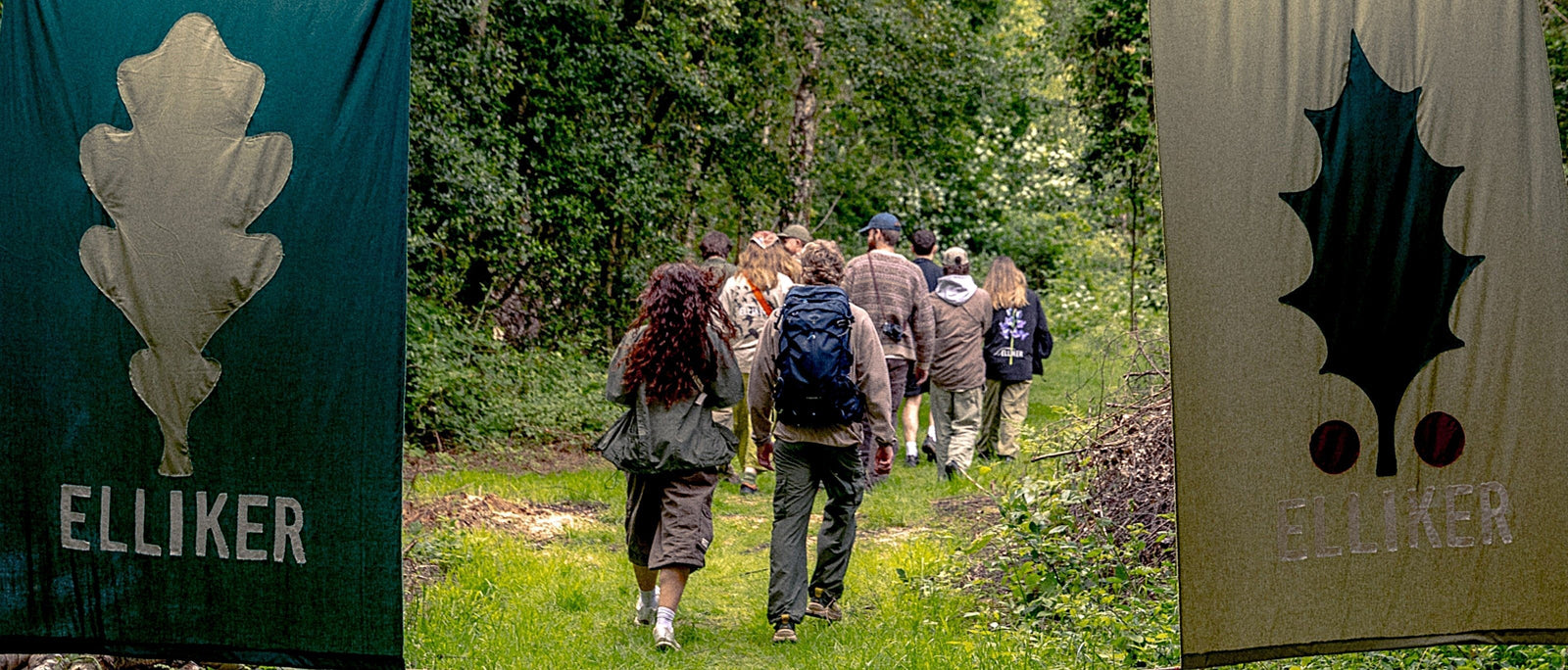
    A group of people walk through a gap between two large fabric banners printed with leaf motifs and the Elliker logo, heading into dense green woodland on a summer's day.

    30th September 2026 | Words by Matt Jones @ WildBounds HQ | Images courtesy of Elliker


    There’s a small nature reserve on the edge of the West Yorkshire village of East Keswick, a few miles north of Leeds. It’s not particularly dramatic – no jutting crags, no jagged skylines – just a south-facing alkaline grassland meadow sitting over magnesian limestone, a strip of managed woodland, and a fen extension acquired piece by piece by the local Wildlife Trust over the better part of three decades. Dog walkers know it. So do local birders, foragers, and whoever shows up for the Tuesday morning volunteer work parties. It’s the kind of place that exists in every corner of Britain, unremarkable to anyone driving past, yet fiercely loved by the people who use it.

    It’s called Elliker Fields. And when Rob and Richard Smith needed a name for the outdoor brand they were starting, that patch of land in East Keswick was the obvious answer.

    In the bag business

    The strange thing, as Rob tells it, is how long it took. “It’s actually quite strange it took us so long to start Elliker,” he says. “Our family has been in the bag business for generations – going back to our great-grandfather, who owned a repair shop in Leeds back in 1910.” The Smiths have been making bags for over a century. They started with handbags. The leap to outdoor gear, when it finally happened, felt less like a pivot than an inevitability. “One day it just clicked that we could combine our love for nature and the outdoors with something we had so much experience in.”

    That combination – deep craft knowledge plus genuine connection to the natural world – is what makes Elliker tick. The first collection launched in late 2022, and the brand has been building steadily since: expanding into clothing, deepening its sustainability commitments, and developing a series of immersive nature projects that has become, in many ways, the brand’s most distinctive asset.

    Richard Smith stands in open scrubland wearing a khaki bucket hat and black fleece, carrying loppers in gloved hands.  Rob Charles Smith, Creative Director & Co-founder [Conservation day Hardknott Pass - Rob.jpg]  ALT: Rob Charles Smith sits on a tree stump on open moorland, wearing a sand shirt and olive trousers with a tan sling bag across his chest, pruning tools resting across his lap

    Richard Smith, Co-founder (left) and Rob Charles Smith, Creative Director & Co-founder (right)


    Familiar places

    The Elliker Fields connection is more than nominal. Rob and Richard grew up in East Keswick, and their family are active members of the Wildlife Trust that protects the reserve. “I remember climbing over the fence to play there as a kid, before it was owned by the Wildlife Trust,” says Rob. “Now we can easily take our own children, as it’s open to the whole village.” The Trust manages around 100 acres of land in total – wet marshland, wildflower meadows, and a mixture of new and ancient woodland, all sitting on that belt of magnesium limestone that gives the meadows their alkaline character and their exceptional wildflower diversity. The brand donates a percentage of its profits directly to the Wildlife Trust, including the East Keswick Wildlife Trust that looks after the very fields and woodland that gave Elliker its name.

    A group of people sweep through long dry grass with insect nets in a sunlit meadow, large trees behind them, during a bug identification day at Elliker Fields.

    A bug ID day at Elliker Fields itself; the wildlife reserve that gave the brand its name


    Born from a local landscape

    The philosophy behind Elliker is, at its core, pretty simple: connect more people with nature, and make sure the gear they carry when they do is worth owning. It’s a brief that sounds easy enough until you start pulling at the threads – at which point questions of material sourcing, environmental impact, what ‘functional’ actually means, and what kind of brand you want to be in the world all start to surface at once.

    Elliker’s answer is to focus on what matters. All bags are made from 100% recycled polyester derived from post-consumer plastic waste, GRS-certified at the fabric supplier level. No fluff, no greenwashing. The materials are exactly what they say they are. Similarly, the waterproof PU coating applied to every bag is free from PFC/PFAS – the harmful ‘forever chemicals’ that are finally being phased out of the outdoor industry. On sustainability, Rob is unambiguous: “It definitely makes things harder for ourselves, especially for a small brand. But we don’t think it would really work if we weren’t trying as hard as we can to make the brand as sustainable as possible given the ethos of the brand. We’ve been doing it from the start and we don’t really see it any other way.”

    ‘Life in the slow lane’

    The brand’s guiding ethos – ‘life in the slow lane’ – is a deliberate rejection of the performance-obsessed end of the outdoor market. Elliker isn’t trying to sell you your next personal best. It’s not interested in fastest known times or summit rounds or kit lists organised by gram weight. What it is interested in is getting people outside and paying attention to what’s actually around them – a completely different relationship with the natural world than the one many outdoor brands are selling.

    Rob puts it bluntly: “We’ve always seen ourselves as an outdoor brand that tries to understand and connect with nature, rather than conquer it, as a lot of ultra-performance brands try to do. Taking time to slow down, appreciate and connect is all part of that. You can’t understand the environment if your goal is to get in and out in the shortest time possible.”

    Two pairs of hands hold a magnifying loupe up to examine a small insect during one of Elliker's nature-focused bug walks.

    Getting into nature, literally – one of Elliker’s community bug walks in action.


    That ethos shows up most clearly in the brand’s ‘Getting Into Nature’ project series – an ongoing stream of editorial content that reads less like branded content and more like genuine, wide-eyed curiosity about the natural world. There are field guides to specific walks – Rombald’s Moor, Scar House Reservoir, Upper Nidderdale – written with the kind of specificity that makes you want to actually go. Deep dives into shinrin-yoku, the Japanese practice of forest bathing; practical guides to wild garlic foraging; sessions on microscopy and mushroom identification; a charcoal burning project examining traditional woodland management; rockpooling; bird watching.

    Three people work around a wooden outdoor table in woodland, folding and preparing white fabric for the natural dyeing process. Bunting hangs in the trees above.

    All Elliker projects are run in-house – the connection always comes from the brand or the founders themselves.


    And then there’s Plant to Pigment: a natural dyeing workshop led by an artist known as Nana Frank, in which participants made pigment from foraged plant material and applied it directly to Elliker and Hikerdelic co-branded tees. The results – earthy, blotched, entirely unique – were left to dry on a washing line strung up by an old Land Rover Defender. As brand activations go, it’s hard to think of one that better captures what Elliker is actually about.

    Naturally dyed Elliker x Hikerdelic t-shirts hang from a washing line strung across the roof of a battered red Land Rover Defender, drying in dappled woodland light.

    Plant to Pigment: natural dyes, woodland workshops, and a battered old Defender.


    All of it is run in-house, built around connections the brand makes itself. “We take the time to find people who look interesting and that we like what they’re doing, then we reach out – it just stems from there,” says Rob. “We have never really used third parties to set up projects, as we feel it’s a lot more genuine if the connection comes from the brand or the founders themselves.”

    The roots of that curiosity, unsurprisingly, go back to East Keswick. “Having grown up in the countryside and having such a close connection to our local Wildlife Trust really shaped our understanding of nature. Really, we’re just trying to share that experience with as many people as possible through the brand.”

    The collaborations

    Elliker’s ongoing collaboration with Hikerdelic – a fellow British brand occupying a space somewhere between psychedelia, early rave culture and genuine love of the outdoors – has produced two funky capsule collections. The draw was instinctive: “We just liked the colourful vibe and their nature-leaning visuals, so it seemed like an easy partnership.” The bags built for the collaboration – in high-performance diamond ripstop nylon with contrast purple trims referencing vintage outdoor gear – capture something that both brands aspire to: the idea that going outside doesn’t require a separate wardrobe, a separate identity, a separate self.

    Two women stand at a white-clothed table set up in a sunny outdoor clearing, with large painted green ELLIKER letters as a centrepiece alongside cans, a lemon, and a bottle of Hendrick's gin.

    Elliker nature projects, like the annual summer solstice get-together, are deliberately informal – more village fête than brand activation.


    Meanwhile, the Trail Dusters hammock camping project (‘Elevate’) takes a similar approach from a different angle: a group of people camping in hammocks in the woods, using Elliker bags, making a case for the kind of low-impact, unhurried outdoor experience that sits at the heart of the brand.

    The rest of the range

    The rest of the product range reflects the same understated logic. Bags in recycled polyester covering the full carry spectrum – roll-tops for commutes and day walks, flap-over backpacks for heavier loads, totes and slings and sacoches for when you just need your phone, your keys, and a snack. The palette runs through khaki, navy, sand, steel blue, and electric purple; the silhouettes are clean.

    The back of a person wearing an olive green Elliker t-shirt printed with a vivid grid of British insects – beetles, a bee, a moth, a butterfly – above the words 'GETTING INTO NATURE'.

    The ‘Getting Into Nature’ project series puts wildlife curiosity at the centre of the brand. The tees do the same.


    The functionality is taken seriously, even if the aesthetic owes more to a walk in the woods than an ice axe. “Just because our campaigns have moths and badgers in them rather than ice axes and avalanches doesn’t mean we don’t pay a lot of attention to the functionality of our products,” says Rob. “We want our gear to be useful for everyday wear as well as when you’re out hiking, so that people get as much use from it as possible.” The product development process starts close to home: “It comes from a combination of what we need ourselves and what we can’t find anywhere else.”

    A person wearing a khaki Elliker flap-over backpack stands in a woodland setting, the bag's bungee lacing and zip details clearly visible.

    The AW26 range: functional carry that works as hard getting to the outdoors as it does once you’re in it.


    A man at night wearing an Elliker jacket and red-light headtorch, a light grey ripstop sacoche bag resting on his chest with a moth landed on it.

    The kind of low-key encounter Elliker’s new collection is built around – moths in the moonlight.

    And the product names? Inspired by Yorkshire, for now at least – the Dayle, the Buckden, the Cautley, the Caley, the Lammer, all of which will doubtless be familiar place names if you also happen to hail from God’s Own Country. “We’re Yorkshire born and bred,” says Rob. “I’m sure we’ll get some names from further afield in time, but there’s still plenty of quality places up here to pick from.”

    Why it matters

    There are plenty of outdoor brands making bags from recycled polyester. There are plenty of brands talking about sustainability, about community, about connection to place. What Elliker does is put those things together without making them the lead, without centring the brand story on its own virtue.

    The brand name is taken from a patch of local wildlife habitat the founders played in as children. The profits go back to the Trust that manages it. The field guides take you to specific places in Yorkshire that actually exist and are worth visiting. The natural dyeing workshop happened in a real wood with a real artist. The bags are well-made, functional, and honestly priced. It’s all done proper, in typical Yorkshire style.

    And the plan for the next five years? Again, characteristically understated. “We started with bags and at our heart I think we will be a bags-first brand,” says Rob. “We are looking forward to building the brand, expanding into some new territories, and to have inspired plenty more people to learn about the natural world that is on their doorstep.”

    Bottom line? Elliker is a brand that would rather show you a good walk than tell you it cares about the environment. In a sector rife with greenwashed marketing b*llshit, that’s worth something.

    [SHOP THE COLLECTION]


    Also in Brands

    18th September 2026 | Words by Matt Jones @ WildBounds H Q
    Direct from Down Under | Our Best Aussie Outdoor & EDC Brands

    From Sea to Summit to Bellroy, discover the best Australian outdoor and lifestyle brands at WildBounds. Direct from Down Under, shipped from the UK.

    VÅGA | The Story
    VÅGA | The Story

    A pandemic project born on the southern fringes of the Lake District, VÅGA set out to fix the one piece of running kit everyone had opinions about and nobody seemed happy with: the cap.

    Two pairs of feet in Darn Tough wool hiking socks kick up through a shower of autumn leaves in Vermont.
    Darn Tough | The Story

    The socks that saved a Vermont factory from bankruptcy – and built a brand with the best lifetime guarantee in the entire outdoor industry.