
Camp
  • Forest Gold: Britain’s Best Places to See Autumn Leaves
    Eight forests, gardens and arboretums where Britain’s woods put on their finest show – plus the science behind the colour, and a few tips for making the most of your walk.

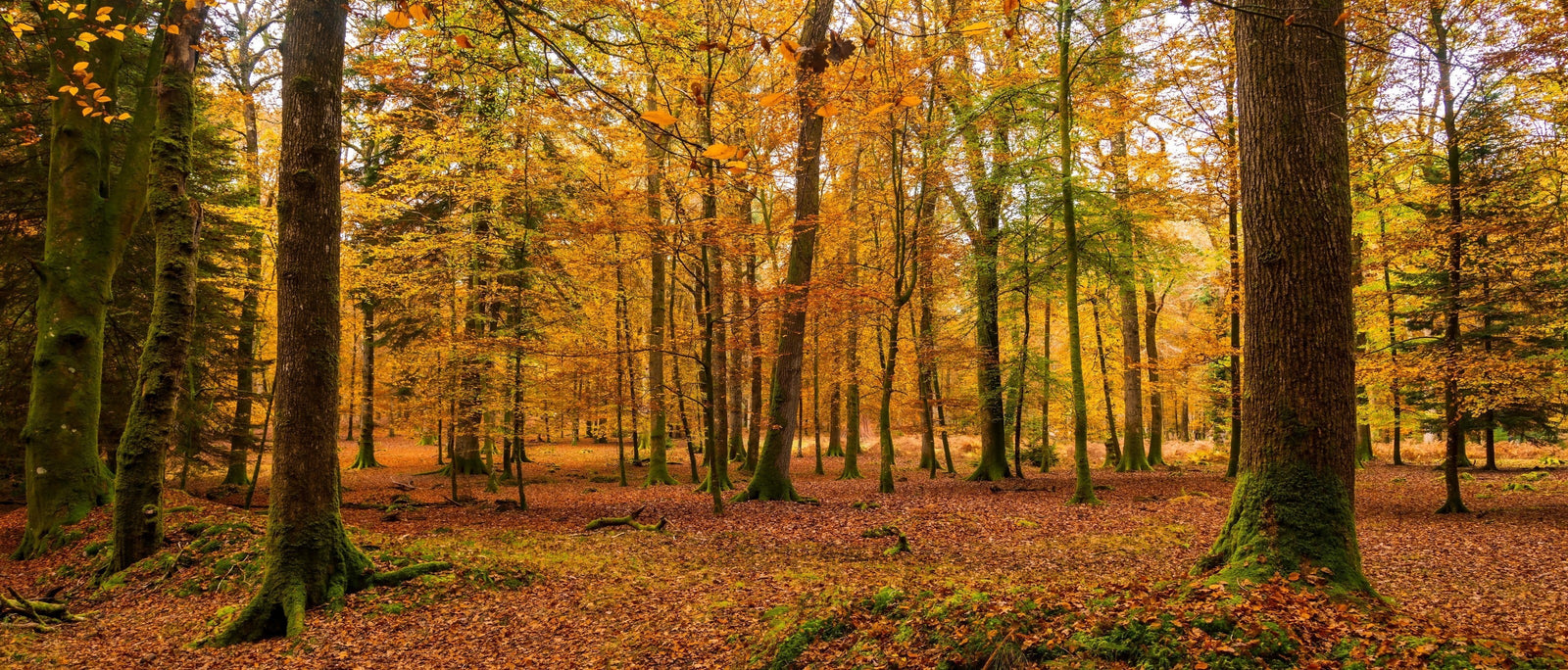
    Tall trees with golden-yellow autumn foliage rising from a carpet of copper leaves in the New Forest, their trunks green with moss. Image by allouphoto via Adobe Stock.

    16th October 20226 | Words by Dave Hamilton | Photos as credited


    Woodland walking in autumn can feel like venturing into another world entirely. It is a rich, multi-sensory experience. You’ll feel and hear leaves crunching softly underfoot, as last night’s rain continues to work its way down through the canopy, occasionally dripping down the back of your neck. Spiralling leaves flutter across your vision as they fall gently to the ground; dust motes catch shafts of sunlight in dappled clearings. Inhale and you’ll get the indescribable scent of petrichor, interspersed with the earthy, musty scent of the forest floor.

    Of course, the real reason that many people love trees in autumn is for their spectacular array of colour; a seasonal spectrum of red, russet, gold, orange and ochre. And while Britain may not have New England’s reputation for fall foliage, we still do autumn rather well. Between carefully planted Victorian arboretums, landscaped Georgian estates, ancient broadleaf forest and pockets of local woodland, there’s no shortage of places to watch the leaves turn.

    Here are eight of the best places to witness autumn in action, from Argyll to Sussex. First, though, a quick primer on what’s actually going on inside those leaves…

    Close-up of maple leaves in autumn, yellow and orange with scarlet streaks along the veins and edges, against a soft green background. Credit: Garden Guru via Adobe Stock

    Chlorophyll clocks off, and the other pigments take the stage. Credit: Garden Guru via Adobe Stock.


    Why do leaves change colour in autumn?

    As the days shorten and the weather cools, chlorophyll – the compound responsible for the vivid green of a tree’s leaves – starts to break down. Once the light-absorbing chlorophyll fades, the other pigments that were hiding behind it are revealed. You may have come across some of them before, as they’re also found in common foods. Carotenoids, which give us the yellows and oranges, are the same compounds you’ll find in carrots and sweetcorn, while anthocyanins – made by some species of tree but not others – are the reds and purples you’ll also find in blueberries and red cabbage. Seen together ranged across a hillside or clustered in a canopy, they give us a kaleidoscope of autumn colour in place of spring and summer green.

    The tree isn’t just letting go, either. Before the leaves drop, it pulls valuable nutrients and sugars back out of them, drawing them into the branches, trunk and roots to be stored over winter. At the same time, a layer of cells (known as the abscission layer) forms at the base of each leaf stalk, sealing the leaf off and cutting any remaining exchange between tree and leaf. Effectively, the leaf is no longer part of the larger organism, and it falls to the ground.

    Where is the best place to see autumn leaves in the UK?

    The turning of the leaves is best seen in either large deciduous forests, ideally with higher ground to give you a view over much of the canopy, or in grand gardens with a wide mix of trees. These eight fit the bill perfectly.

    A flame-red Japanese maple at Benmore Botanic Gardens.

    A flame-red Japanese maple at Benmore. Credit: kloniwotski via Flickr.


    1. Benmore Botanic Garden, Argyll

    In the west of Scotland, tucked away at the end of Loch Eck, you’ll find Benmore Botanic Garden. The gardens are a rich tapestry of native and exotic trees which really come into their own late in the year. Japanese maples sit alongside other exotics such as Persian ironwood and Enkianthus, a kind of heather on steroids which puts on a dazzling, vibrant show of colour. This is also a great place to see larches, one of the only deciduous conifers, as they turn a beautiful golden yellow.

    Branch out at Benmore Botanic Garden

    Aerial view of Hatchmere in Delamere Forest, Cheshire, ringed by pine woodland with swathes of golden larch in the foreground.

    Larch gold and a silver lake: Hatchmere from above. Credit: Philip via Adobe Stock.


    2. Delamere Forest, Cheshire

    With cycle trails, bridleways, footpaths, and even a treetop adventure course, Delamere Forest is one of the easiest woodlands to explore in the North West of England. Managed by Forestry England, it is part of the Mersey Forest initiative, a scheme set up to increase areas of woodland close to large urban populations. It is also part of the Northern Forest, whose goal is to plant 50 million trees between the Yorkshire Coast and Liverpool. Autumn is a fine time to go: the larches on the Old Pale hillside make a warm backdrop as you arrive, oak, chestnut and beech glow gold and copper through the forest, and Forestry England recommends the Blakemere Trail for the best of the colour.

    Branch out at Delamere Forest

    Picnic benches on the bank of the River Ystwyth at Hafod Estate, Ceredigion, with budding trees, conifer-clad hills and a blue sky.

    Hafod in spring – just wait until October, when the oak and beech turns. Credit: trevormayes via Adobe Stock.


    3. Hafod Estate, Ceredigion

    Situated in the Ystwyth valley in Ceredigion, Hafod is a little-known gem in a seldom-visited corner of Mid Wales. Between the late 18th and early 19th centuries, Colonel Thomas Johnes ordered the planting of three million trees on his estate. His planting was sympathetic to the topography of the land, using Scots pine and larches on the higher ground and deciduous oaks and beeches on the more fertile lower reaches. Despite this obvious planning and planting, the area has a wild feel about it, and in autumn the display of colour has little rival in the region. Today the estate is cared for by National Trust Cymru in partnership with Natural Resources Wales, who took over from the Hafod Trust in 2022 and continue its balance of conservation and restoration.

    Branch out at Hafod Estate

    Orange beech leaves above a woodland floor of rust-brown bracken, with oak trunks and green foliage behind, near Parkend in the Forest of Dean.

    Bracken rust and beech fire in the Forest of Dean. Credit: Stephen via Adobe Stock.


    4. Forest of Dean and Wye Valley, Gloucestershire and Monmouthshire

    The Wye Valley was a hotspot for Victorian and Georgian holidaymakers and day-trippers. The area has continued to attract people to this day, and during the autumn months, tourists flock to the region for ‘leaf peeping’ tours. A trend which has come over from North America, the Forest of Dean and Wye Valley tourist board have put together a fifty-mile circular route from Chepstow in the south to Coleford and beyond in the north. You can download the Leaf Peeping drive guide (PDF) to plan your own trip.

    Branch out in the Forest of Dean and Wye Valley

    Scarlet, orange and gold trees reflected in a lake at Sheffield Park, with the turreted house in the distance under a heavy grey sky.

    Sheffield Park, where the lake doubles the intensity of the autumn colour. Credit: Marius Comanescu via Adobe Stock.


    5. Sheffield Park and Garden, Sussex

    Despite its name, Sheffield Park isn’t in the north of England but in the leafy county of Sussex. It’s also famous for its autumn colour, and the garden was planted with the season in mind: maples, tupelos and swamp cypress set the place ablaze, and the lakes double the effect with their reflections. Booking is needed to guarantee entry during the busy autumn season, so check before you go.

    Sheffield Park actually takes its name from John Baker Holroyd, the 1st Earl of Sheffield, who is often cited as being responsible for the transformation of the gardens, although it’s unlikely he did any of the design or physical work himself. Instead, he employed a team of landscapers working under the much-lauded Lancelot ‘Capability’ Brown and the lesser-known Humphry Repton. Although Brown was involved, it was Repton’s team who really created its woodland, planting 1,000 larch, 100 acacias, 260 silver firs, 200 chestnuts, 1,100 oaks, 9,450 ash, 30 planes, 16 walnuts and 8 Portugal laurels. Today it is run by the National Trust, so you can guarantee there’ll be a decent scone and cuppa in the café and, if you are so inclined, a Jilly Cooper book in the second-hand bookshop.

    Branch out at Sheffield Park and Garden

    Sunlit woodland on Hampstead Heath with a thick carpet of fallen orange leaves, a silver birch on the left and amber foliage behind.

    Ankle-deep in amber on Hampstead Heath. Credit: David via Adobe Stock.


    6. Hampstead Heath, London

    With striking views of the city, flanked by autumn colour, Hampstead Heath is the ideal spot for the capital’s photographers to come on a hazy November afternoon. For the classic shots, head for Lime Avenue, which turns into a golden tunnel, and Viaduct Pond, where the surrounding colours reflect in the water. Over at Kenwood, some of the more exotic species put on a dazzling display of their own. It’s one of the highest points in London and, at 320 hectares (around 790 acres), also claims the largest single area of common land in Greater London. The woods, made up of native and naturalised beech, oak, hornbeam, field maple and horse chestnut, are a haven for fungi and mosses. They’re also rich in wildlife, and the ancient woodland around Kenwood is designated a Site of Special Scientific Interest (SSSI) for its mix of mature trees and dead wood habitat. All that rotting timber makes the perfect home for the nationally rare, iridescent jewel beetle.

    Branch out on Hampstead Heath

    One of Westonbirt’s famous Japanese maples in resplendent red. Credit: whitcomberd via Adobe Stock.

    One of Westonbirt’s famous Japanese maples in resplendent red. Credit: whitcomberd via Adobe Stock.


    7. Westonbirt Arboretum, Gloucestershire

    Westonbirt has a staggering 15,000 trees and shrubs, with more than 2,500 different species giving a riot of varying colour, size and shape in the autumn months. They’re gathered from all over the globe and include the national collections of Japanese maples, walnuts, limes and maples, as well as the national collection of bladdernuts, which put on impressive displays in both spring and autumn. Winding through the arboretum’s canopy, the 13m-high, 300m-long treetop walkway has been open since 2016. Designed by Glenn Howells Architects, working with structural engineers Buro Happold, it’s accessible to buggies, wheelchairs and mobility scooters. Along with the walkway, you’ll also find a café on site, plus self-guided or guided walks throughout the park. As one of the best places to see autumn colour, it goes without saying that Westonbirt gets busy: pre-booking is required on peak autumn dates (in recent years, roughly late September to mid-November), so check the dates and book your place on the Forestry England website.

    Branch out at Westonbirt Arboretum

    Two walkers and a dog on a gravel path through tall trees, with a golden-yellow canopy overhead and copper leaves covering the slope.

    Gold overhead, crunch underfoot. Credit: Indra via Adobe Stock.


    8. The National Forest, Midlands

    Over nine and a half million trees have been planted since the 1990s to create The National Forest, Britain’s first large-scale forest for a thousand years. Spread across 200 square miles of Leicestershire, Derbyshire and Staffordshire, it sits on what was historically one of the country’s least forested areas, with new planting joining up fragmented pieces of woodland across an ex-industrial landscape. With public access at the forefront, there are 320km of promoted walks throughout the woods. For autumn colour, the National Trust’s Calke Abbey and Staunton Harold estates are two good places to start: Calke is a blaze of colour in the season, while Staunton Harold pairs reservoir views with parkland in reds and oranges.

    Branch out in The National Forest

    Autumn leaves FAQs

    How do I find an autumn forest near me?

    Although these are some of the best places to see the turning of the leaves, Forestry England have also put together an interactive map to find other English woodlands. Search by your postcode to find a forest near you. Visit Wales has provided a similar guide here. And for unmissable autumn adventures in Scotland, read Scotland-based journalist and blogger Fiona Russell’s article on our very own Journal.

    When is the best time to see autumn leaves in the UK?

    Colour usually peaks in early October in Scotland and mid to late October further south, but the weather has the final say. The best displays follow sunny, dry autumn days with cold but not freezing nights, while a warm, dry start to the season can push the colour change later. Check opening dates before you go, too – Benmore, for one, usually closes for the winter at the start of November.

    Which trees give the best autumn colour?

    Beech, field maple, oak, rowan and hawthorn are all reliable performers. Beech turns burnished gold and copper, field maple goes butter yellow and rowan can flare orange and red. For the richest reds and purples, look to exotics such as Japanese maples and Persian ironwood – which is a big part of why arboretums and botanic gardens put on such a show.

    Can I see good autumn colour away from forests and gardens?

    Absolutely. Bracken fades to a rusty copper across the hills as the season goes on, birch lights up hillsides and glens in yellow, and a larch plantation can still be glowing gold well into November. Pick a clear day, gain a bit of height and you’ll get the whole canopy in one view.

    What should I wear for an autumn woodland walk?

    Layers! Mornings can be seriously chilly and afternoons surprisingly mild, so a breathable base layer, an insulating mid layer and a packable waterproof will cover most days. Wet leaves and roots are notoriously slippery, so choose sturdy footwear with decent grip. Maybe a head torch in the bag too – the clocks go back at the end of October, and dusk arrives earlier than you’d think.

    How do I photograph autumn leaves?

    Overcast days are your friend: soft light stops the colours washing out and keeps harsh shadows off the canopy. If the sun does come out, shoot with it behind the leaves so it glows through them, and don’t ignore the ground – a carpet of fallen leaves can make a better picture than the trees above it. A polarising filter, if you have one, cuts the glare off wet leaves and deepens the colours.


    Dave Hamilton is a writer, photographer, forager and explorer of historic sites and natural places. He is the author of multiple books, including "Where the Wild Things Grow: the Foragers Guide to the Landscape", “Wild Ruins” and “Wild Ruins BC”. His latest book, “Weird Guide Britain”, published by Wild Things Publishing, came out in May 2026.

    Website Twitter

    Also in Culture & Pioneers

    Silhouette of a red deer stag at sunrise, head raised and antlers swept back, with a plume of breath glowing in the golden light. Photo by DreamsCanBe via Adobe Stock
    The Deer Rut: Where to Watch Britain’s Wildest Autumn Spectacle

    Every autumn, Britain’s stags settle their differences the loud way. Here’s where to find the best of the action, from wild moorland to country estates, and how to watch it safely.

    Uffington White Horse. Prehistoric Bronze Age chalk hill figure Oxfordshire, England. Close up over head, eye, ears and neck. By David Matthew Lyons via Adobe Stock.
    Walking into Other Worlds | Britain’s Real Fantasy Locations

    From a chalk horse cut into Oxfordshire hillside to a Pembrokeshire beach scattered with painted pebbles, Britain is full of places where real and imagined worlds collide. Here are six locations that inspired some of fiction’s greatest fantasy writers.

    Close-up of a vintage Crosley record player with a Columbia Records vinyl playing, shot from above on a warm wooden surface
    Ultimate Log Cabin Albums: 10 LPs to Disappear Into the Woods With

    Rain drumming on the roof, a whiff of woodsmoke in the air, and no signal for miles around – we reckon these are the ten albums that should sit right next to the record player in any backwoods retreat.